


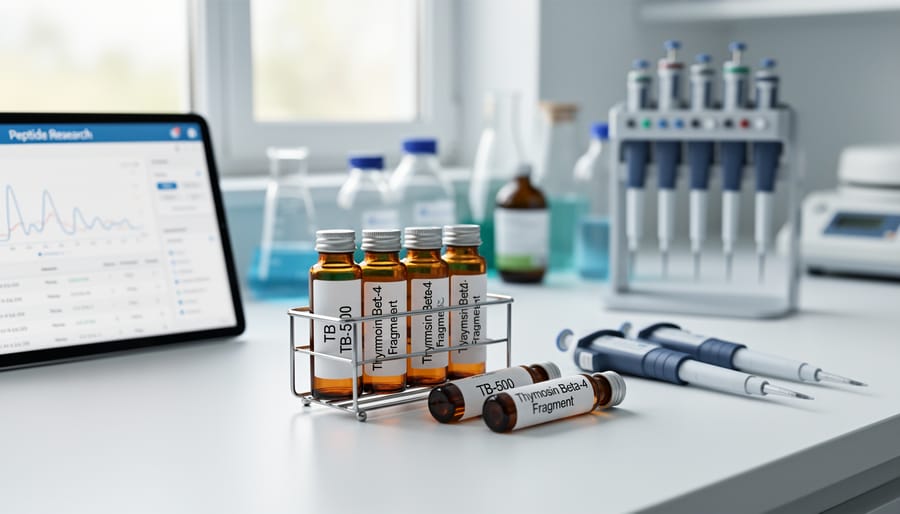
TB-500 is a synthetic peptide fragment based on thymosin beta-4, a 43-amino-acid protein found naturally in nearly all human and animal cells, and it is sometimes sold in combination products such as the https://kylopeptides.com/product/wolverine-stack/. It’s most often described as a shorter, lab-made version of the full protein’s active region, the stretch researchers associate with actin binding and cell movement. That relationship is the source of most confusion, since TB-500, thymosin beta-4, and the sequences sold under similar names are frequently treated as interchangeable when they aren’t.
The topic matters because interest in these peptides has outpaced clear, neutral explanations. Much of what circulates online mixes preclinical findings with marketing language, and TB-500 itself is not an approved medicine for human use. Understanding what it is, how it’s thought to work, and what the research does and doesn’t show is the first step in judging any claim you encounter.
This article walks through the definition, the proposed mechanism, the differences between the full-length protein, a fragment, and an active-region sequence, and how the compound is discussed in research settings. You’ll also see how combination products are positioned, so you can evaluate that kind of description with a clear head. We close with practical ways to verify credentials and question bold promises before you trust them.
What TB-500 Means: A Plain-Language Definition
Where the Research Started
Thymosin beta-4 was first isolated in the 1960s and 1970s during work on thymic extracts. Researchers were looking for the signaling molecules behind immune function, and thymosin beta-4 turned up as one of several small peptides in that mix. It was later found in nearly every cell type in the body, which suggested a role far broader than immunity alone.
That discovery shifted the focus. Scientists began studying how the peptide interacts with actin, the protein that gives cells their shape and lets them move. Because cells must migrate to close a wound or build new vessels, the connection drew attention. Early laboratory and animal studies reported that thymosin beta-4 appeared to influence cell migration and tissue repair processes. These were preclinical observations, and they don’t establish proven results in people.
A few terms come up constantly in this literature:
- Thymosin beta-4
- A naturally occurring 43-amino-acid peptide found in cells throughout the body.
- TB-500
- A synthetic fragment based on the part of thymosin beta-4 that researchers associate with its activity.
- Peptide fragment
- A shorter chain of amino acids taken from a larger protein, often made synthetically for study.
- Actin
- A structural protein involved in cell shape and movement, and the main focus of thymosin beta-4 research.
- Research-use-only labeling
- A designation meaning a product is sold for laboratory work, not as an approved treatment for people.
Keeping these definitions straight makes later claims easier to judge.
How TB-500 Is Thought to Work in Laboratory Studies
Researchers who study thymosin beta-4 and its fragments usually start with actin. Think of actin as the scaffolding and cables inside a cell, a network of tiny filaments that gives the cell its shape and lets it move. Cells constantly build and dismantle these filaments, much like a crew raising and striking a tent.
Thymosin beta-4 is known to bind actin in its loose, unassembled form. In lab terms, it helps manage the supply of building blocks, so a cell can release them when it needs to extend, crawl, or reshape itself. The TB-500 fragment is built around the stretch of the molecule that researchers connect to this actin-binding behavior, which is why the two are discussed together.
From there, the proposed story moves to cell migration. A cell that can reorganize its scaffolding quickly can move toward a target, such as the edge of a scratch in a dish of cultured cells. Some laboratory studies have looked at whether the peptide affects how fast cells travel in these settings.
Another area of interest is blood vessel formation, called angiogenesis. New vessels grow when cells migrate and organize into tubes, so scientists have examined whether actin-related effects might influence that process in cell cultures and animal models.
Here is the important boundary. These are hypotheses and preclinical observations, not proven explanations of what happens in a person. Findings in a petri dish or a rodent often fail to carry over to humans, and the mechanisms above are still being worked out.
When you see confident claims about what TB-500 “does,” check whether they cite preclinical work or actual human evidence. The difference matters.

Thymosin Beta-4 Versus TB-500: Types and Components Explained
Researchers and marketers use several overlapping names for this peptide family, and the differences matter. Here is how the main forms break down.
- Full-length thymosin beta-4: the naturally occurring 43-amino-acid peptide found in cells throughout the body, studied in laboratory and animal work.
- TB-500 fragment: a synthetic peptide based on a portion of the thymosin beta-4 molecule, made in a lab rather than extracted from tissue.
- Active-region sequence: the short stretch of amino acids, often cited as a roughly seven-residue segment, that researchers associate with actin binding and the protein’s reported activity.
- Purity testing: analytical results, commonly from chromatography, showing how much of a sample is the intended peptide.
- Third-party testing and certificates of analysis: independent lab documentation tied to a specific batch.
Size is the clearest dividing line. The full-length protein is the largest and the only one that occurs naturally. The fragment is shorter, which makes it simpler and cheaper to synthesize, while the active-region sequence is the smallest of the three. Because each is a different molecule, findings about one cannot be assumed to carry over to another, even though product listings often blur them together.
In research settings, the full-length protein tends to appear in studies of the body’s own biology, while fragments and short sequences show up in preclinical experiments and as laboratory reference materials. Treat any claim that casually swaps the names with caution.
Quality documentation deserves the same scrutiny you would give a solar panel’s rated specifications. Reviewers look for a certificate of analysis that matches the batch number, identifies the exact peptide, reports a purity figure, and comes from an independent lab. Vague wording, missing batch details, or a certificate that cannot be verified are all reasons to look more closely before trusting a supplier’s description.
How TB-500 Is Used and Discussed in Research Settings
In the research literature, TB-500 shows up mostly in preclinical work. Scientists have examined it in cell cultures and animal models, looking at tissue repair, inflammation and cell migration. It also serves as a laboratory reference material, a known compound used to calibrate assays or compare results across studies. None of that amounts to proof of human benefit, and it’s worth keeping that line sharp.
The regulatory context is fairly consistent in general terms. TB-500 is not an approved therapy, and suppliers typically label it for research use only. In competitive sport, it falls under anti-doping rules, so athletes who ignore that do so at real risk to their careers.
Because the market is murky, reviewers lean on verified documentation such as certificates of analysis, and on third-party testing of purity and identity. Those are the same habits that serve buyers well in any technical sector.
Is TB-500 the same as thymosin beta-4?
Not exactly. Thymosin beta-4 is the full-length, naturally occurring protein, while TB-500 is a synthetic fragment based on a portion of it, though marketing often uses the terms loosely.
Is it approved for human use?
No. TB-500 is not an approved therapy, and the research behind it is largely preclinical.
Why is it labeled research-use-only?
The label signals that it is intended for laboratory investigation, not for treating or diagnosing any condition in people.
Is it permitted in competitive sport?
Generally no. Anti-doping rules cover it, so athletes subject to testing should check current regulations before considering any such compound.

Evaluating Claims and Suppliers: Lessons for Directory-Based Marketing
Whether a listing promises a miracle peptide or a record-breaking solar panel, the same habits protect you. Start by separating claims from evidence. A supplier who cites a certificate of analysis, names the testing lab, and lists batch numbers is giving you something to check. One who relies on phrases like “clinically proven” without a source is not.
Ask for documents, then confirm they’re real. For solar, that means verifying installer licenses, manufacturer certifications, and independent performance testing. For research peptides, it means third-party purity results you can trace back to an accredited lab.
Consider a regional solar installer that began publishing its inspection reports and equipment test data on its listing. Inquiries slowed at first because buyers asked harder questions, but the leads that remained closed faster and with fewer disputes. Transparency screened out poor fits and built confidence in the rest.
Directories work best when they reward that openness. As a reader, treat missing documentation as information too.
TB-500 is a synthetic fragment modeled on thymosin beta-4, a naturally occurring peptide that researchers have studied for its role in cell movement and tissue repair. That’s the core of it. Most of what’s known comes from laboratory and animal work, and those findings don’t translate neatly into proven human outcomes. It isn’t an approved therapy, and the evidence is still preliminary.
The practical lesson reaches well beyond peptides. Whether you’re weighing a research compound, a solar inverter, or a financing offer, lean on credible sources, insist on verified documentation, and consult qualified professionals. Clear claims backed by transparent proof are a good sign. Vague promises are not.